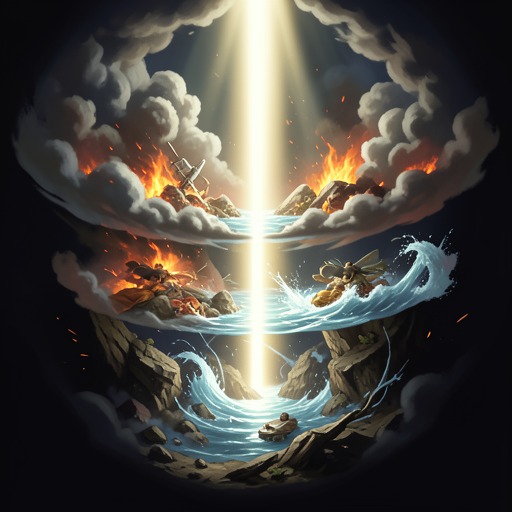
All things are altered, nothing is destroyed
Metamorphoses (Ovid Edition)“All things are altered, nothing is destroyed” is the governing expression of a world in which change replaces annihilation as the fundamental law of existence. It gathers physical metamorphosis, bodily death, and the migration of the spirit into one claim: forms perish, but being continues in another shape. The expression gives the poem’s transformations a philosophical coherence, turning a succession of strange changes into a sustained argument about continuity beneath apparent loss.
Definition and Philosophical Claim
The expression is first stated through the paradox that what is called death is merely “old matter dress’d / In some new figure, and a vary’d vest.” Death appears final only because observers mistake the disappearance of a familiar form for the destruction of what composed it. The language of clothing makes identity appear changeable without making existence vanish: matter removes one garment and assumes another. The decisive contrast is therefore not life versus nothingness, but former shape versus succeeding shape.
The doctrine is stated with deliberate simplicity: “Thus all things are but alter’d, nothing dies.” Its force lies in the balance between the two clauses. The first denies permanence to visible forms; the second denies absolute destruction. Together they establish alteration as universal and death as a misleading name for transition. The maxim is not limited to human bodies. It describes the operations of Nature as a whole, where every apparent ending becomes material for another state.
The Movement of Spirit and Form
The expression also applies to the unbodied spirit. Once dispossessed by time, force, or sickness, the spirit may move onward, either entering another body or remaining outside one until it finds “ready limbs.” It then animates those limbs according to their kind. The body is consequently a temporary dwelling rather than the permanent definition of the self, while the spirit is the continuing principle that crosses the boundaries between forms.
This movement produces a sharp distinction between soul and figure: “The soul is still the same, the figure only lost.” The visible body can disappear, decay, or be exchanged, but the animating identity persists through the loss. The expression thus joins two kinds of continuity. Matter changes its arrangement, and spirit changes its dwelling; neither process requires the conclusion that existence has been erased. Metamorphosis becomes the observable surface of a deeper persistence.
Nature as an Unceasing Process
The expression recurs in the description of changing figures, where Nature is presented as an active power continually revising the world. “Thus are their figures never at a stand, / But chang’d by Nature’s innovating hand.” No form remains fixed, because Nature continually alters appearances, bodies, and conditions. The verb “innovating” gives change a productive rather than merely destructive character: Nature does not simply ruin forms but brings forward new ones.
The final formulation makes this process theatrical: “The shifted scene for some new show employ’d.” A changed world resembles a stage whose scenery is rearranged for another performance. The scene has shifted, but the material of the drama remains available for renewed use. This image preserves both loss and continuity. A particular figure is gone, yet the larger world has not been emptied; its elements have been recruited into another arrangement.
Birth, Death, and Recurrent Transformation
The doctrine reverses ordinary definitions of birth and death. Death is old matter clothed in a new figure, while birth is “to begin to be / Some other thing we were not formerly.” Birth therefore marks a new configuration rather than an absolute beginning, just as death marks a change rather than absolute extinction. Each moment of existence contains a before and an after, and each form is temporary in relation to the transformations that precede and follow it.
This framework makes metamorphosis the poem’s central mode of explanation. A figure may become something radically different, yet the change remains part of a continuous natural history. The expression does not claim that forms are preserved unchanged; on the contrary, it insists that forms are repeatedly lost. What it rejects is the inference that the loss of form equals the destruction of substance or spirit.
Narrative and Thematic Significance
As a recurring principle, “All things are altered, nothing is destroyed” converts transformation from marvel into law. Individual metamorphoses may produce grief, fear, wonder, or astonishment, but the expression places them within a larger pattern in which alteration governs gods, humans, animals, bodies, and the elements alike. Its repeated emphasis on change prevents the poem’s catalog of transformations from becoming a collection of isolated curiosities.
The expression also gives apparent death a double meaning. At the level of personal experience, a body, identity, or familiar relationship can genuinely be lost; at the level of Nature, however, the materials and spirits involved continue their circulation. The result is neither simple consolation nor simple denial of suffering. Loss remains real as the loss of a particular figure, but it is not the last truth about existence. The final image of matter being employed for a new show leaves the reader with a universe in motion, where every ending is also the preparation of another form.